Stocks rally in Asia, US tariffs not as dire as feared
European and US stock futures advance as proposed tariffs on 14 trading partners appear less severe than anticipated; Nvidia shares fall 3.9% amid credit rating downgrade concerns.
Asian equity markets recovered on Thursday as investors assessed the latest US tariff proposals to be less damaging than initially feared, while the Thanksgiving holiday provided some respite from the recent sell-off in artificial intelligence (AI) stocks, Reuters reported.
The White House proposed new tariffs targeting 14 major trading partners, including China, Japan and the European Union. However, the proposed duties will not be imposed on top of those introduced in July and are unlikely to take effect before February or March.
JPMorgan analysts expect the additional tariffs to have a relatively modest macroeconomic impact, given that the investigations were announced well in advance and several major import categories, including technology products, remain exempt.
European equity futures advanced, with EURO STOXX 50 futures rising 2.3%, Germany’s DAX futures gaining 2.1% and Britain’s FTSE futures climbing 1.4%.
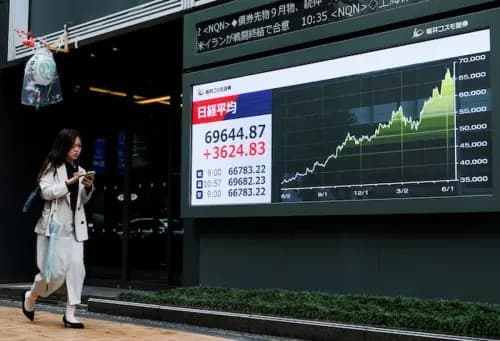
In Asia, Japan’s Nikkei gained 1.6%, South Korea’s benchmark index rose 1.9% and Taiwan’s main index advanced 1.4%. Despite the recovery, Japanese equities remain down 8% this month, while South Korean and Taiwanese markets have lost 16% and 15%, respectively.
The broader Asia-Pacific equity index excluding Japan rose 1.8%, although Chinese blue-chip stocks struggled to register gains.
US equity futures also strengthened, with S&P 500 futures advancing 0.7% and Nasdaq futures gaining 1.1%.
Nvidia remained a source of investor concern after S&P Global Ratings placed the chipmaker’s credit rating on watch for a potential downgrade, citing weaknesses in management and board oversight.
Nvidia shares closed 3.9% lower at $149.30 on Wednesday, leaving the company’s market capitalisation approximately $2.3 trillion below its October peak, when its shares traded at $243.37.
Meanwhile, bond markets reflected expectations that substantial losses across global equities and uncertainty over the sustainability of AI-related business investment could restrain further monetary tightening by central banks.
US Treasury yields touched multi-week lows on Wednesday despite an upward revision in third-quarter US economic growth to 4.3% and an increase in the Federal Reserve’s preferred measure of core inflation to 3.3%.
Interest rate futures indicated a 98% probability of a 25-basis-point Federal Reserve rate increase in December, although expectations of a larger 50-basis-point increase have diminished.
The yield on 10-year US Treasury bonds stood at 4.848%, having touched an 11-week low overnight.
Stephen Brown, chief North America economist at Capital Economics, said the proposed tariffs were likely to result in a smaller increase in the effective US tariff rate than previously anticipated. However, the additional duties could still exert upward pressure on prices and keep core goods inflation elevated into 2027.
In currency markets, declining Treasury yields limited the US dollar’s recent gains, with the dollar index easing to 103.79.
The Swiss franc strengthened against the dollar, which fell to 0.8318 francs, while the euro stabilised at $1.0965 after recently touching $1.0881.
The dollar remained broadly unchanged against the Japanese yen at 159.15, with the possibility of currency market intervention limiting its advance towards the 160 level.
Oil prices increased after Yemen’s Houthis claimed to have attacked Saudi Arabia’s largest oil refinery, raising concerns over potential supply disruptions in the Middle East.
Brent crude futures rose 0.7% to $95.25 per barrel, while US crude futures gained 0.6% to $84.32 per barrel.
Gold advanced 0.2% to $3,589 per ounce after declining more than 7% so far this month and touching its lowest levels in a year.