Is Namira Salim or Zeeshan Ali the real first Pakistani astronaut?
Pakistan has a new astronaut to celebrate, but the arrival of Muhammad Zeeshan Ali at China’s Tiangong space station has reignited a debate over who actually deserves the title of the country’s first astronaut.
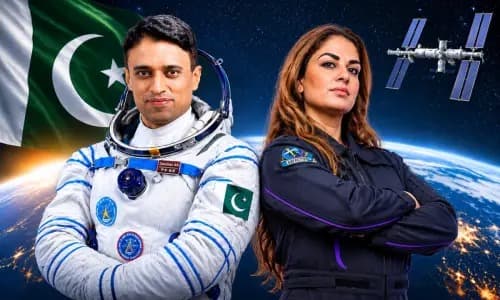
Pakistan has a new astronaut to celebrate, but the arrival of Muhammad Zeeshan Ali at China’s Tiangong space station has reignited a debate over who actually deserves the title of the country’s first astronaut.
Ali made history on November 25, 2026, when he travelled aboard China’s Shenzhou-24 mission, becoming the first Pakistani to enter Earth’s orbit and the first foreign national to visit China’s Tiangong space station. He is also the first Pakistani selected to participate in China’s crewed space programme.
But there is a complication: a Pakistani had already travelled to space three years earlier.
That person is Namira Salim, who flew aboard Virgin Galactic’s commercial Galactic 04 mission on October 6, 2023. The Karachi-born adventurer became the first Pakistani to travel to space, reaching an altitude of approximately 87.4 kilometres before returning to Earth.
Salim has now pushed back against the use of the title ‘Pakistan’s first astronaut’ for Ali, maintaining that she was officially recognized by the Pakistani government as the country’s first astronaut in 2006.
Speaking to Independent Urdu, she said the Ministry of Information and Broadcasting had introduced her to the country under that title after she became one of Virgin Galactic’s founding astronauts. She bought her ticket in 2006, but it took nearly 18 years for the commercial spaceflight programme to become operational.
She has welcomed Ali’s achievement but argues that her own milestone should not be overlooked.
“First Pakistani astronaut is Namira Salim, that’s me,” she said, while acknowledging that it was a positive development that Pakistan had finally kicked off its human space flight programme in cooperation with China, which would not be as expensive.
“A plethora of people dream of going into space, may their dream come true. I have set this example of going into space and will keep doing so and if my work benefits others then it is the biggest reward for me.”
To a query, she said, “If the government overlooks this [feat] and ignores efforts of a private citizen, then it’s its own problem.”
Salim said the government of Pakistan had launched her in 2006 as a first Pakistani astronaut and she reached space after 18 years as the company of which she had bought tickets took this long to complete the test flights and other procedures to launch private space flight in the US.
“I want to clarify here that even though I live outside Pakistan but I have no other passport than Pakistani,” she said, maintaining that even the interim government had recognized her in 2023.
So, what’s the difference between the two?
The answer lies in the type of spaceflight they undertook.
Salim travelled on a suborbital flight. Virgin Galactic’s spacecraft was carried to a high altitude by a mothership before being released and firing its rocket engine. It travelled beyond the recognized US boundary of space, gave its passengers a few minutes of weightlessness, and then returned to Earth.
However, it did not enter Earth’s orbit.
Ali, on the other hand, travelled aboard a rocket-powered spacecraft that entered orbit around Earth before docking with China’s Tiangong space station. He is participating in scientific experiments and space station activities as a payload specialist, alongside Chinese astronauts.
In simple terms, Salim travelled into space and came back, while Ali travelled into orbit and reached a space station.
There is also an interesting technical detail: where exactly does space begin?
There is no universally agreed boundary. The US recognizes 50 miles (approximately 80.5 kilometres) above Earth as the boundary of space. The Fédération Aéronautique Internationale (FAI), which governs international aeronautical and astronautical records, uses the Kármán line at 100 kilometres.
Salim’s flight reached 87.4 kilometres. This means it crossed the US-recognized boundary but did not reach the internationally used 100-kilometre Kármán line.
Ali’s orbital flight, meanwhile, took him well beyond both thresholds.
So, is Namira Salim Pakistan’s first astronaut or is that title now Muhammad Zeeshan Ali’s?
The most accurate distinction is that Salim was the first Pakistani to travel to space, while Ali is the first Pakistani to enter Earth’s orbit and visit a space station.
They are two different milestones, both historic for Pakistan. The debate perhaps says as much about how we define an astronaut as it does about who deserves the title.