Power generation rises 8.7% in October as fuel costs jump 24.9%; coal and oil fill the LNG gap
Demand on the grid is recovering after two years of decline and two of stagnation, but four of six LNG cargoes failed to arrive. As oil and imported coal filled the gap, distribution companies want Rs2.88 a unit more from consumers.
Pakistan's power plants produced 10,744 gigawatt-hours (GWh) of electricity in October 2026, 8.7% more than a year earlier, according to power sector data analyzed by Arif Habib Limited (AHL).
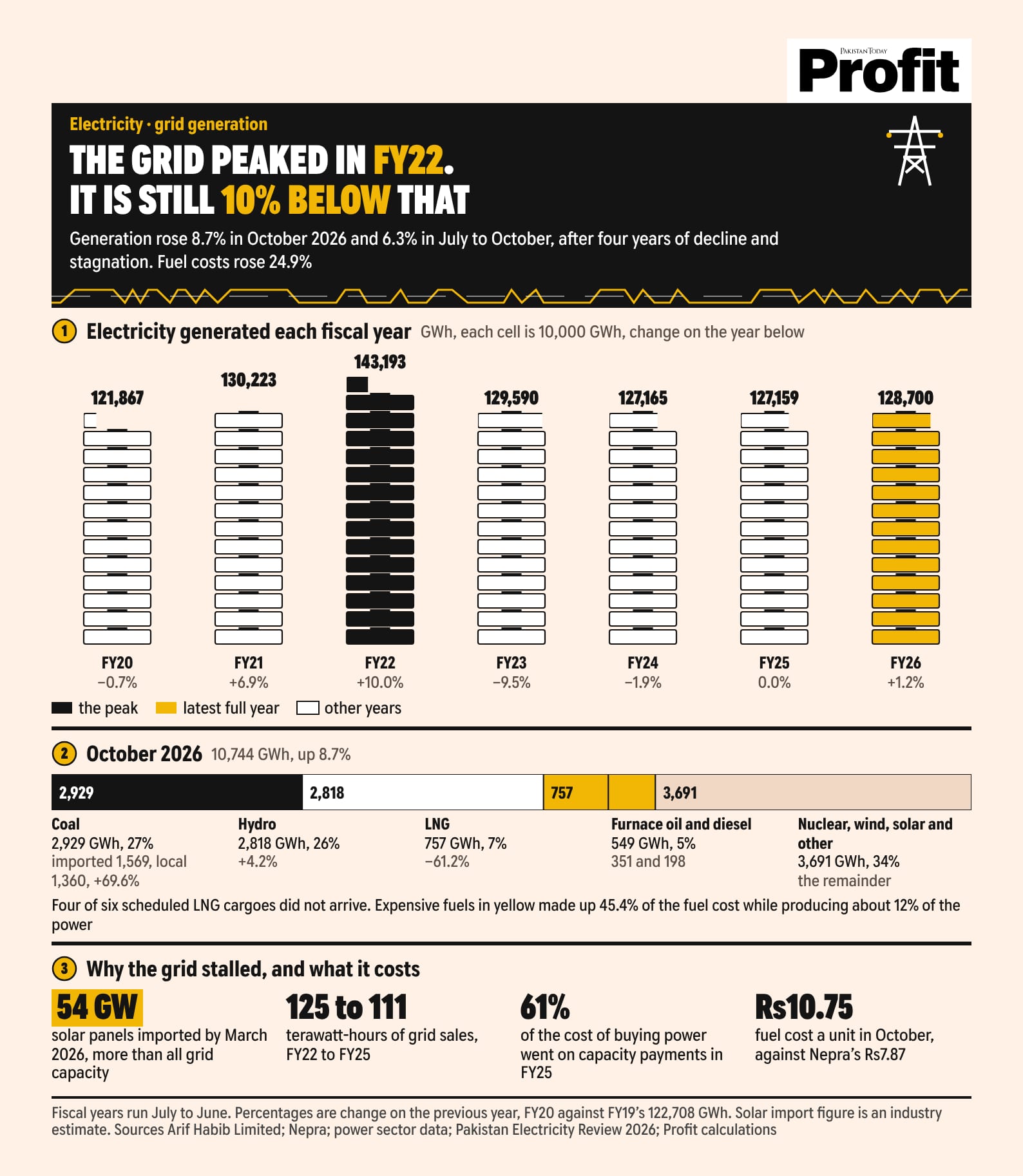
It cost far more to make. The average fuel cost reached Rs10.75 per unit, against the Rs7.87 the National Electric Power Regulatory Authority (NEPRA) had built into tariffs. Distribution companies have asked to recover the Rs2.88 difference through a fuel cost adjustment (FCA) on consumers' bills, a 37% overshoot.
The reason is gas. Pakistan State Oil received only two of the six long-term liquefied natural gas (LNG) cargoes scheduled for October. Power plants that would have burned LNG ran instead on imported coal, furnace oil and diesel.
Generation rose 6.3% over the first four months of the fiscal year, July to October. October's output was 3.4% above the seven-year average for the month, though still 4.9% below the October 2021 peak of 11,296 GWh.
What filled the gap
LNG-based generation fell 61.2% to 757 GWh. The fuel cost of electricity made from re-gasified LNG reached Rs28.74 a unit, almost three times the average.
Coal took most of the load. Coal plants produced 2,929 GWh, up 69.6% and the most for any October on record. That is 27.3% of all electricity generated in the month.
Imported coal did the heavy lifting. Its output rose 237% to 1,569 GWh. Plants burning local Thar coal produced 1,360 GWh, up 7.9%.
Oil came back into the mix. Furnace oil plants produced 351 GWh and diesel plants 198 GWh. Together with LNG, these three fuels made up 45.4% of the unadjusted average fuel cost of Rs10.63 a unit, while producing about 12% of the electricity.
Hydropower was steady. Output rose 4.2% to 2,818 GWh, in line with the long-term October average, as water availability improved.
Who pays
The FCA passes changes in monthly fuel costs straight to consumers, after Nepra reviews them. If approved in full, consumers will pay Rs2.88 more for every unit, at a time when the government has been trying to bring tariffs down. In June, the adjustment was Rs1.20, driven by the same expensive LNG.
But not everyone loses. Furnace oil plants such as Nishat Power and Nishat Chunian Power earn more when they run more often under their revised contracts, which pay partly for capacity and partly for electricity actually delivered.
The generation was also above Nepra's reference level. That spreads fixed costs, mostly capacity payments, across more units, which tends to lower the per-unit charge in the next quarterly tariff adjustment.
A grid that stopped growing
October's rise comes off a low base. Grid generation peaked at 143,193 GWh in 2021-22. It fell 9.5% to 129,590 GWh the next year as tariffs rose sharply, slipped to 127,165 GWh in 2023-24, and stayed flat at 127,159 GWh in 2024-25. In 2025-26, it grew 1.2% to 128,700 GWh, still 10% below the peak.
The economy grew over the same period. The grid did not.
The solar effect
Pakistan had imported nearly 54 gigawatts (GW) of solar panels by March 2026, according to industry estimates, more than the entire capacity connected to the national grid.
Most of it sits on rooftops, in factories and on farms, out of the grid's sight. Net-metered solar, the part officially connected to the grid, grew from 0.7 GW in 2021-22 to 8.3 GW by December 2025. Distributed solar produced an estimated 51 terawatt-hours in 2024-25, equal to well over a third of grid generation.
Every unit a household makes on its roof is a unit it no longer buys. Grid sales fell from 125 terawatt-hours in 2021-22 to 111 terawatt-hours in 2024-25, even as the number of consumers grew.
Paying for plants that sit idle
Most of what consumers pay for is not fuel. It is capacity. Power plants built under contracts with the government are paid a fixed capacity charge whether they run or not. In 2024-25, capacity payments made up 61% of the total cost of buying power, and the capacity charge per unit sold rose from Rs10.11 in 2022-23 to Rs14.21 in 2024-25. Fewer units sold means each one carries more of that fixed cost.
The government's answer was to rewrite the contracts. Between late 2024 and early 2025, it terminated agreements with six independent power producers (IPPs), revised tariffs with 14 IPPs set up under the 1994 and 2002 power policies, and renegotiated terms with bagasse plants and its own government-owned plants. It put the savings at about Rs3.5 trillion over the remaining life of the contracts.
Many of the revised contracts moved from take-or-pay, under which plants are paid for availability regardless of use, to a hybrid take-and-pay model, under which part of the payment depends on electricity actually bought.
Bringing industry back
The other answer was to make the grid cheaper for industry and captive power dearer.
The government cut industrial tariffs by Rs4 a unit, offered incentives to industrial and agricultural users, and raised levies on gas burned by factories in their own captive power plants. Those measures supported generation between December 2025 and March 2026.
Large-scale manufacturing grew 1.9% year on year in the first two months of 2026-27. The sector still loses money between the plant and the meter. Power sector circular debt, the chain of unpaid bills running from distribution companies back to power producers, stood at Rs1.675 trillion at the end of June 2026, up Rs34 billion in a year.
The government has refinanced Rs1.225 trillion of it through a six-year facility from commercial banks. The Power Division blamed most of the latest increase on unpaid bills for grid electricity supplied to K-Electric, which is tied up in a tariff dispute in court.
An expensive fuel month adds to that pressure. Fuel cost adjustments are recovered months after the fuel is burned, and every unpaid or stolen unit widens the gap.
Selling the Discos
The government's longer bet is to hand the distribution companies (Discos), where most losses from theft and unpaid bills sit, to private owners.
The first batch is Faisalabad Electric Supply Company (Fesco), Gujranwala Electric Power Company (Gepco) and Islamabad Electric Supply Company (Iesco). The Privatisation Commission's board approved restructuring plans in July, under which a government-owned company will take over selected assets and liabilities before the sale.
Interest has been strong. Iesco drew 10 expressions of interest in September, three from Turkish investors and seven from local groups, including Engro Energy and a Hubco-led consortium, each seeking 51% to 100% of the company with management control. Ten parties have been prequalified for Fesco, and 11 expressions of interest for Gepco are under evaluation.
The buyers will inherit the grid's central problem. A private Disco earns from selling units, and its best-paying customers are the ones most able to put panels on their roofs.
What the planners expect
Nepra projects electricity demand growth of 1% in 2026 and 2.6% in 2027 under its base case.
The national generation plan for 2025 to 2035 assumes more. Its medium case has demand growing about 3.5% a year, reaching 198,963 GWh by 2035. Even its low case, after subtracting net-metered solar, assumes 1.8% a year.
The gap between those numbers is the risk consumers have to carry. If demand grows more slowly than planned, any new plant built for it adds capacity payments without adding sales.
Nepra will hear the Rs2.88 adjustment request before deciding how much reaches bills.
The LNG shortfall is the variable to watch. If cargoes stay short through winter, when gas is also needed for homes, the power sector will keep leaning on imported coal and oil.
The Disco sale moves to due diligence. The government has not said when bids will close.