Dubai awards $15.4bln in new contracts for Al Maktoum International Airport
Cumulative value of contracts and packages awarded for the airport development to approximately $22bln.
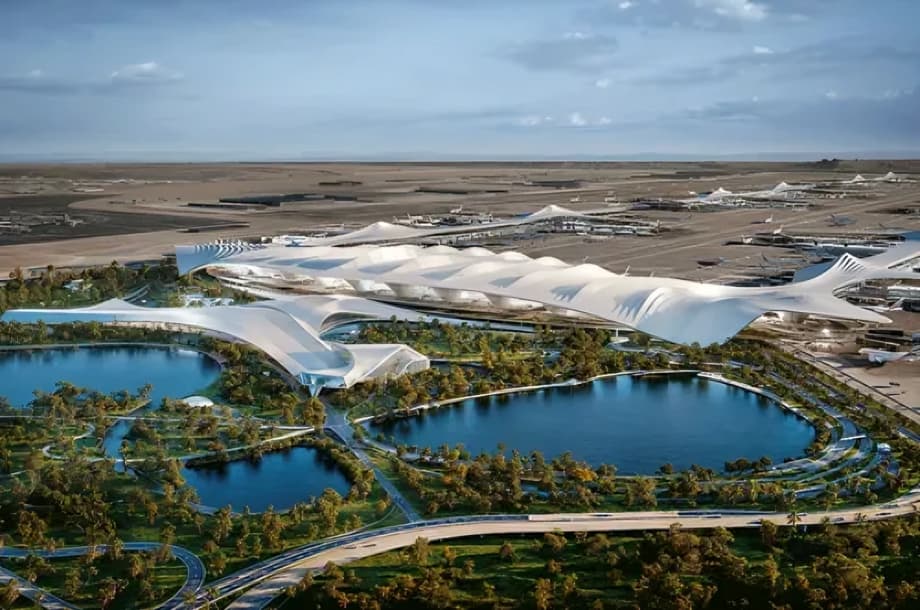
Dubai has awarded new contracts worth approximately 56.5 billion UAE dirhams ($15.4 billion) for the development of Phase 1 of the Al Maktoum International Airport, taking total awards to roughly AED 80 billion dirhams ($21.8 billion) as the emirate pushes ahead with a project it estimates will cost $35 billion.
The contract awards were announced on Thursday by Sheikh Hamdan bin Mohammed bin Rashid Al Maktoum, Crown Prince of Dubai, Deputy Prime Minister and Minister of Defence of the UAE, and Chairman of The Executive Council of Dubai.
These awards will enable construction to advance concurrently across several key components of Phase 1, supporting the coordinated development of the airport's passenger facilities, underground transportation networks, utilities and operational infrastructure, an official statement said.
Dubai Aviation Engineering Projects (DAEP) had previously awarded contracts and packages worth approximately AED 23.815 billion ($6.48 billion) for Phase 1, covering enabling works, substructure packages, automated people mover (APM) and baggage handling systems (BHS).
Sheikh Ahmed bin Saeed Al Maktoum, Chairman of Dubai Aviation City Corporation and DAEP, confirmed that the airport development has entered a phase of large-scale construction.
“We are moving decisively ahead with Phase 1 in accordance with the approved programme. The contracts and delivery sequence have been structured to sustain parallel progress across multiple sites while upholding the highest standards of quality and safety,” he said.
New contract packages
The latest awards cover four major areas of Phase 1.
West Terminal Building and Concourse 1: The packages cover substructure and associated infrastructure works, including basements, underground tunnels, access ramps, short-term car parks and the Ground Transportation Centre.
The scope also includes metro interface works, landside bridges, underground Ground Service Equipment (GSE) circulation corridors, the principal BHS backbone network and utility infrastructure covering electricity, water supply, telecommunications, sewerage and stormwater drainage.
Concourses 2 and 3: The contracts cover superstructure works, including the main concourse buildings, rotundas, structural steel bridges and supporting structures for passenger boarding bridges.
The scope includes the fabrication and installation of large-span steel roof space frames and supporting vertical structures, building façades, roofing systems, architectural fit-out, mechanical, electrical and plumbing (MEP) installations and Special Airport Systems.
Concourse 4: The substructure package covers basements, underground tunnels, access ramps, GSE circulation corridors, utility networks and underground infrastructure forming part of the BHS backbone network.
Power infrastructure: The electrical infrastructure package covers the construction of two principal 132/11-kilovolt (kV) substations, associated power cabling and related electrical infrastructure.
The scope includes construction, installation, testing, commissioning and handover of the substations and associated systems.
The statement did not disclose the names of the winning contractors, individual contract values or package completion timelines.
Construction progress
DAEP said enabling works in the Concourse 2 and Concourse 3 zones and the central area of the airport site are nearing completion.
Enabling works are continuing within the central passenger terminal zone, comprising the West Terminal, Concourse 1 and the Ground Transportation Centre, as well as the Concourse 4 area.
Total excavation across the project has exceeded 24.23 million cubic metres, while backfilling has exceeded 5.2 million cubic metres, with 7,635 piles completed.
More than 875,603 cubic metres of concrete have been placed and over 226,270 tonnes of reinforcement steel installed under the Concourses 2 and 3 substructure packages, including BHS tunnels and GSE routes.
The combined workforce across these packages currently stands at approximately 14,000 personnel, with cumulative working hours exceeding 21.3 million.
DAEP is responsible for the integrated delivery of the airport development programme, covering planning, design, procurement, construction and operational readiness, as well as managing technical interfaces between contract packages and monitoring cost, schedule, quality and safety performance.
In August 2026, Indian engineering conglomerate Larsen & Toubro (L&T) announced that its consortium with Mitsubishi Heavy Industries (MHI) and MHI Mobility Engineering Services (MHI-MESC), the Dubai subsidiary of MHI, has secured a “large” order to design and build the automated people mover (APM) system for the first phase of Al Maktoum International Airport.
DXB to Al Maktoum International
Earlier this month, UAE-based English language newspaper Gulf News reported that the new airport will be operated without passengers for at least a year before opening it to the public, quoting Dubai Airports CEO Paul Griffiths.
The first phase is scheduled to start commercial operations in 2032 with a capacity for 150 million passengers annually.
Sheikh Hamdan had earlier announced approval of the extension of the Dubai Metro to Al Maktoum International Airport City with a budget of AED 2 billion ($544 million). The extension will create a 3km route with two new stations, directly linking the existing Route 2020 line to the Al Maktoum International Airport City.
Scheduled to start operations in 2031, the project will be developed jointly by Dubai’s Roads and Transport Authority (RTA) and the Dubai Engineering Projects Establishment.
In September 2026, Dubai-based project news portal MEED reported that US-based engineering consultancy Aecom has been awarded the design contract.
Additionally, the new airport will be linked to a high-speed railway line between Dubai and Abu Dhabi. It is also planned to be linked to the existing Dubai International Airport (DXB) via a 55-kilometre Airport Express Line featuring five stations. The project is undergoing feasibility study.
Emirates Airline to invest up to $12bln
In November 2025, Emirates Airlines’ Chairman and Chief Executive, Sheikh Ahmed bin Saeed Al Maktoum told Gulf News that the airline plans to invest a minimum of $10 to $12 billion in developing its dedicated infrastructure at Al Maktoum International Airport.
In January 2026, Emirates signed an agreement with Dubai Investments Park (DIP) to acquire land for a new mixed-use Cabin Crew Village designed to accommodate up to 12,000 cabin crew members. Phase 1 is expected to be completed in 2029.
In May 2026, Emirates broke ground on its new $5.1 billion maintenance, repairs and overhaul (MRO) complex at Dubai South. The facility will span 1.1 million square metres (sqm), making it one of the largest buildings in the world by volume and the largest steel structure in the GCC. Construction of the facility is expected to be completed by the middle of 2030.
Al Maktoum International Airport is set to become the world’s largest aviation hub, with an annual capacity exceeding 260 million passengers and 12 million tonnes of air cargo upon completion of its final phase. The airport will feature five parallel runways operating independently, two passenger terminals, and seven concourses connected to more than 430 aircraft stands.