US midterm elections: What El-Sayed’s historic victory means for Muslims in America and beyond
The election of Abdul El-Sayed to the United States Senate marks a historic moment for American Muslims and Muslim communities around the world. By defeating Republican candidate Mike Rogers in Michigan’s Senate race, El-Sayed has become the first Muslim ever elected to the US Senate. His victory is not simply a political milestone; it represents a significant moment in the ongoing struggle over Muslim identity, representation, Islamophobia and the place of Muslims in American public life.
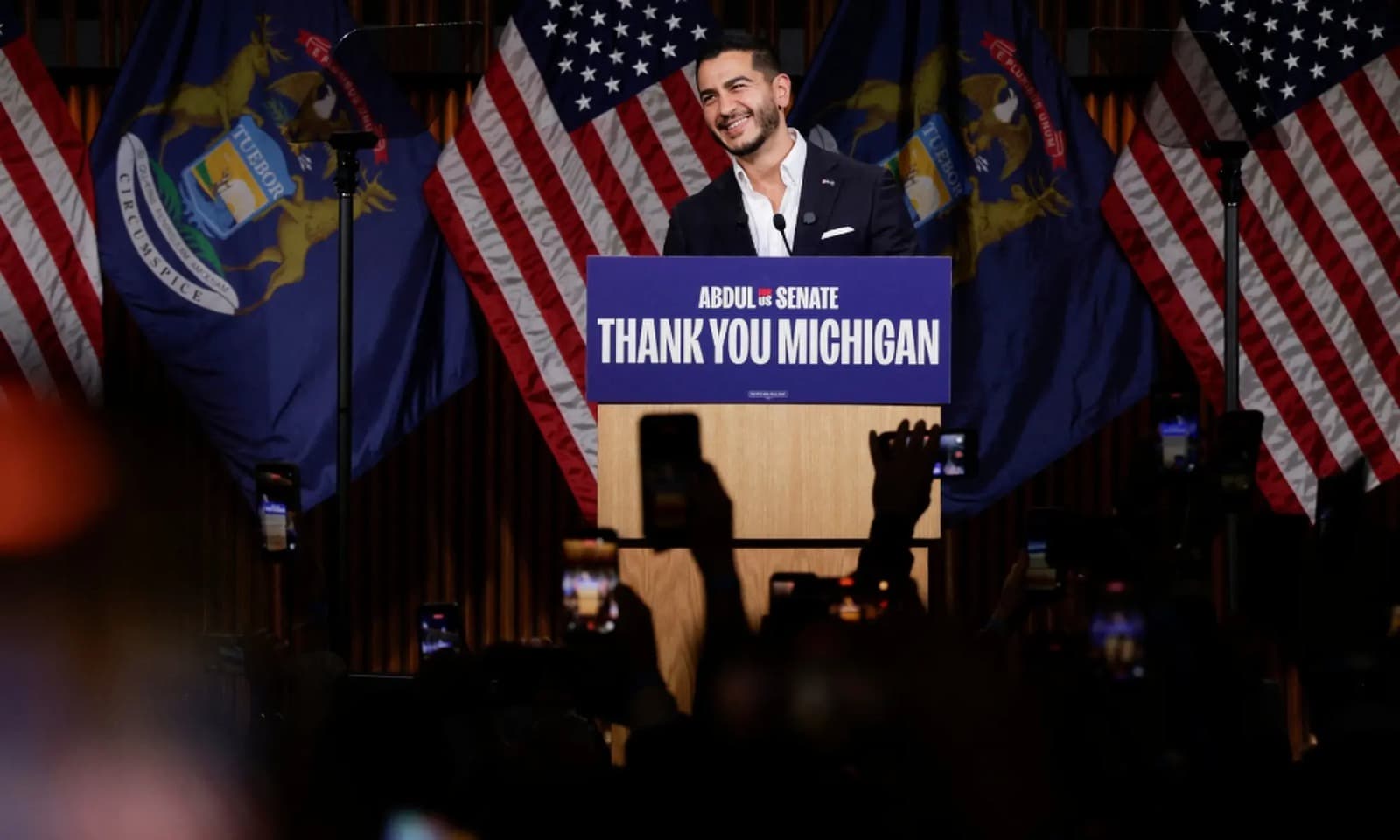
The election of Abdul El-Sayed to the United States Senate marks a historic moment for American Muslims and Muslim communities around the world. By defeating Republican candidate Mike Rogers in Michigan’s Senate race, El-Sayed has become the first Muslim ever elected to the US Senate. His victory is not simply a political milestone; it represents a significant moment in the ongoing struggle over Muslim identity, representation, Islamophobia and the place of Muslims in American public life.
At a time when Muslims in the United States have faced increasing political scrutiny, anti-Muslim rhetoric and questions about their loyalty to the country, El-Sayed’s success carries significance well beyond Michigan.
Who is Abdul El-Sayed?
Abdul El-Sayed, 42, is an Egyptian-American physician, public health expert and progressive Democratic politician. Born in the United States to Egyptian immigrant parents, he previously served as director of the Wayne County Department of Health in Michigan.
He first attracted national political attention in 2018 when he ran for governor of Michigan, although he lost the Democratic primary. Eight years later, he has reached an extraordinary political milestone by winning a seat in the US Senate.
His campaign centred on healthcare reform, economic inequality, reducing the influence of wealthy donors in politics and challenging American military spending overseas. He has advocated universal healthcare through Medicare for All and has been an outspoken critic of US support for Israel.
According to the Associated Press, his grassroots campaign overcame substantial spending by political opponents, including significant spending by pro-Israel lobbying interests during the Democratic primary.
Al Jazeera reported that his victory represents a setback for established political interests and a breakthrough for progressive politics in America.
A victory against Islamophobia?
Perhaps the most significant dimension of El-Sayed’s victory is the political climate in which it happened.
His Muslim identity became a central issue during the campaign. President Donald Trump repeatedly attacked him, calling him a “jihadist” and questioning his loyalty to America. Other Republican politicians attempted to associate him with the Muslim Brotherhood, allegations El-Sayed rejected. He explicitly denied membership of the organisation and affirmed his commitment to the US Constitution.
The BBC reported on Trump’s attacks, including his invocation of the September 11 attacks while campaigning against El-Sayed. Critics described the remarks as Islamophobic, arguing that they sought to portray a Muslim political candidate as a security threat simply because of his religious identity.
In an interview with CNN, El-Sayed argued that some politicians were attempting to portray America as too small to accommodate people of different religious backgrounds.
His electoral success therefore sends an important message: Muslim identity does not automatically disqualify someone from the highest levels of American political leadership.
What does his victory mean for Muslims in America?
For America’s estimated millions of Muslim residents, El-Sayed’s election offers something particularly important: representation.
Muslims have long been part of American society, contributing to its economy, education, healthcare, culture and public institutions. Yet their representation in national political leadership has remained limited.
El-Sayed’s arrival in the Senate challenges the perception that Muslim Americans can participate in democracy only as voters and community activists, rather than as lawmakers and national decision-makers.
His victory also provides encouragement to younger Muslim Americans who have grown up witnessing political debates in which their religion is frequently associated with extremism, terrorism and questions of national loyalty.
Importantly, his success does not mean Islamophobia has disappeared. Indeed, the hostility directed towards him during the campaign demonstrates that anti-Muslim prejudice remains a significant feature of American political discourse.
His election may, however, make it more difficult for political opponents to portray Muslims as outsiders who do not belong in American public life.
What does it mean for Muslims internationally?
Beyond America’s borders, El-Sayed’s victory is likely to resonate particularly strongly across the Muslim world, including the Middle East, North Africa and South Asia.
For many Muslims watching American politics, the significance is symbolic. A Muslim man born to Egyptian immigrant parents has overcome a campaign in which his religion and background were repeatedly questioned to secure a seat in one of the world’s most powerful legislative institutions.
His outspoken criticism of unconditional American military assistance to Israel will also attract international attention, particularly among Muslims concerned about Palestinian suffering and American foreign policy.
However, it is important not to confuse his religious identity with a mandate to represent all Muslims internationally. El-Sayed is an American politician elected to represent Michigan, not a representative of the global Muslim community.
His victory also does not automatically signal a change in Washington’s foreign policy. His influence will depend on his legislative position, political alliances and ability to build support within the Senate.
More than a religious milestone
Ultimately, Abdul El-Sayed’s victory is about more than becoming America’s first Muslim senator. It is about challenging assumptions concerning who belongs in American democracy.
For Muslims, it offers a powerful image of political inclusion at a time when their identity is frequently politicised. For immigrant communities, it demonstrates the possibilities of democratic participation across generations.
And for the wider world, it presents an important question: can a country that has often struggled with religious and racial divisions fully embrace the diversity of its own population?
El-Sayed’s victory does not answer that question completely. But it represents a significant step towards doing so.
Written by
People First