Two cops escorting polio team martyred in Mohmand attack amid nationwide drive
Two policemen escorting polio vaccination teams were martyred and another injured in a gun attack in Mohmand, KP, amid the nationwide immunization drive. The attack followed the abduction of four polio workers in Tank as Pakistan targets nearly 24 million children across 97 districts
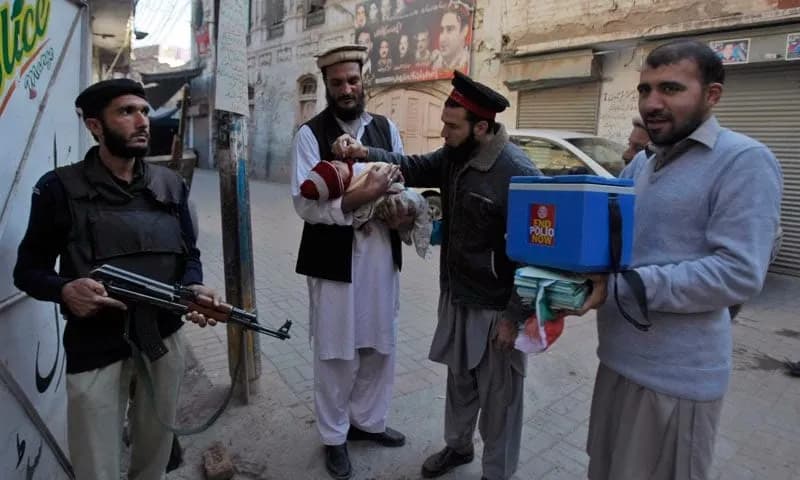
PESHAWAR: Two policemen escorting polio vaccination teams were martyred and another injured in a gun attack in Khyber Pakhtunkhwa's Mohmand district on Tuesday, a day after four polio workers were abducted in Tank, as Pakistan launched a major nationwide immunisation campaign amid persistent security threats.
The latest attacks came two days after Pakistan confirmed its eighth polio case of 2026, involving a 13-month-old girl from Khyber district, according to the National Emergency Operations Center for Polio Eradication on Sunday.
Six of the eight polio cases reported this year have been detected in Khyber Pakhtunkhwa, while the remaining two were reported in Sindh.
DSP Headquarters Liaquat Ali confirmed the casualties, saying the attack took place near the Hashim Khan police checkpost in the Dag Tamanzai area of Pindiali tehsil in Mohmand district.
He identified the martyred policemen as Constables Zahoor Khan and Arbai Khan, while the injured personnel was identified as Sepoy Sabir Khan.
The latest incidents underscore the persistent security challenges facing Pakistan's efforts to eradicate polio, a crippling disease that remains endemic only in Pakistan and neighbouring Afghanistan.
The ongoing nationwide campaign, running from November 2 to 8, aims to vaccinate nearly 24 million children under the age of five across 97 districts.
Interior Minister Mohsin Naqvi strongly condemned the attack and paid tribute to the policemen who laid down their lives while protecting the national cause.
“The firing incident targeting police personnel deployed to protect a polio team is intolerable,” Naqvi said in a statement.
He paid homage to the martyred officers and called for those responsible for the attack to be brought to justice.
Later in the day, funeral prayers for the two martyred policemen were offered at the Police Lines in Ghalanai. The funeral was attended by the Commandant Mohmand Rifles, deputy commissioner, district police officer, other officials and local residents.
Senior officials laid floral wreaths on the bodies of the martyred policemen, offered condolences to their bereaved families and paid tribute to their sacrifices in the line of duty.
A day earlier, four polio workers were abducted by unidentified armed men in Tank, prompting KP Governor Faisal Karim Kundi to call for their immediate and safe recovery.
“The abduction of polio workers is an extremely regrettable and condemnable incident,” Kundi said in a statement.
He said ensuring the safety of vaccination teams was the government's responsibility and called for effective measures to protect health workers and security personnel deployed during the campaign.
Polio vaccination teams and their police escorts have repeatedly come under attack, particularly in Khyber Pakhtunkhwa, where militants have targeted immunisation campaigns amid longstanding misinformation and suspicion surrounding vaccines.
Although polio infections have declined sharply compared with previous years, the virus continues to circulate in high-risk areas, posing a threat to children who miss vaccination.
Pakistan reported 31 polio cases in 2025, compared with 74 in 2024, according to government figures.
Meanwhile, the National Emergency Operations Center said more than 6.68 million children had received polio drops on Monday, the first day of the latest nationwide campaign, which involves more than 200,000 health workers going door to door.
More than 1.37 million children were vaccinated in Khyber Pakhtunkhwa alone on the opening day, it added.
Polio is a highly infectious disease that can cause irreversible paralysis, particularly among children under five. Although there is no cure for the disease, repeated vaccination can prevent infection and protect children from lifelong disability.
Written by
People First