
RWE and KKR close £12bn wind investment
RWE and KKR have finalised financing for two offshore projects. Vanguard West and Vanguard East will deliver 2.8GW of generating capacity off Norfolk, with 184 Vestas turbines and full commissioning targeted for 2030.
RWE and KKR have completed financial close on the Vanguard West and Vanguard East offshore wind projects off Norfolk, securing the capital arrangements for approximately £12 billion of investment in generation and transmission infrastructure.
The transaction completes a 50:50 joint venture between the two companies and establishes non-recourse project financing from 35 international banks. Together, the wind farms will provide around 2.8GW of installed capacity, with offshore construction expected to begin in early 2027 and both projects scheduled for full commissioning in 2030.
KKR has acquired a 50% equity stake in each development, completing the partnership initially announced in January 2026. RWE will lead construction and project delivery on behalf of the joint venture, while both companies contribute equity alongside the financing provided by lenders.
The agreed financing comprises £11.1 billion in cash facilities and £1.7 billion in ancillary facilities. These represent different elements of the project financing structure and should not be added to the £12 billion investment estimate as though they were separate construction programmes.
The package includes a £1 billion commitment from the UK's National Wealth Fund, with additional credit support from Germany's Euler Hermes and Denmark's export credit agency EIFO. RWE describes it as the largest non-recourse financing secured for UK offshore wind.
Under non-recourse project financing, lenders principally rely on the project assets and associated revenue arrangements to support repayment, rather than having unrestricted access to the sponsors' wider corporate assets. This structure allows major infrastructure developments to raise capital against their anticipated operating cash flows.
Vanguard West and Vanguard East are located between 50km and 80km off the Norfolk coast. Each development has a planned capacity of approximately 1.4GW and will require substantial manufacturing, marine construction, electrical installation, and commissioning activity before electricity generation can begin.
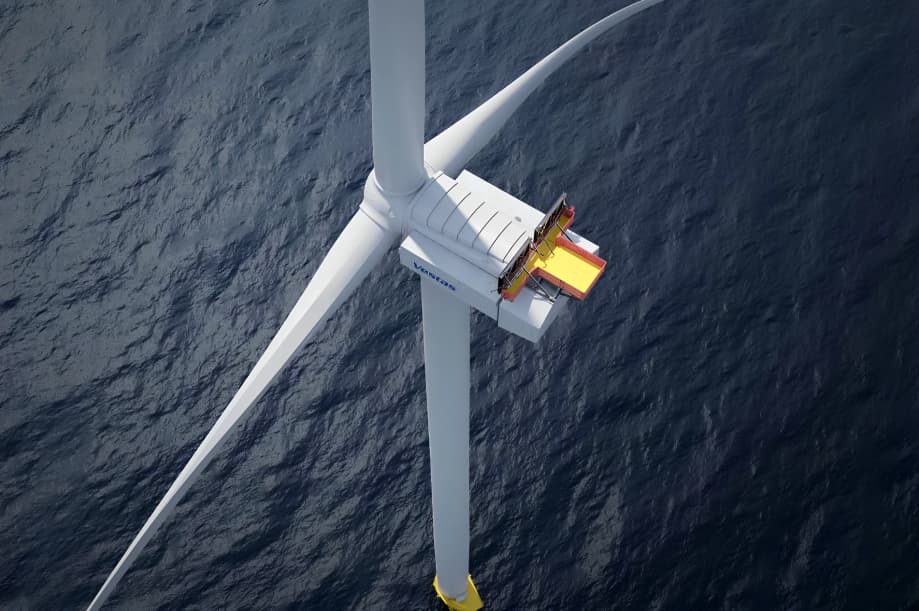
Vestas has secured contracts to supply 92 V236-15.0MW offshore wind turbines to each project, giving a combined requirement of 184 machines. The turbines have a rotor diameter of 236 metres and a swept area exceeding 43,000 square metres, with tip heights above 260 metres.
Manufacturing components at this scale requires specialised production equipment and substantial space for assembly, inspection, and handling. Rotor blades must maintain the required aerodynamic geometry while resisting repeated mechanical loading, and their dimensions create restrictions on transport from factory to installation port.
The turbine supply contracts cover delivery and commissioning, making equipment manufacturing closely dependent on the offshore construction schedule. Components must arrive in a sequence that matches the availability of foundations, installation vessels, and suitable weather windows.
RWE has also awarded Lamprell contracts for the manufacture and transportation of 92 transition pieces for each wind farm. These structures provide the interface between the foundation and the turbine tower, transferring loads while accommodating installation and maintenance requirements.
Transition piece production involves heavy steel fabrication, welding, dimensional verification, and corrosion protection. Their construction must meet the tolerances required for installation on the completed foundations, where adjustments become considerably more difficult than in a controlled fabrication environment.
The transition pieces will be delivered to a staging port before offshore installation. The arrangement requires coordination between manufacturing output, marine transportation, temporary storage, and the sequence in which foundations are installed.
Electrical infrastructure represents another substantial portion of the programme. Power generated by individual turbines will be collected through subsea array cables and transferred towards the onshore electricity network through the export system.
Offshore wind electrical systems must accommodate changing generation as wind conditions vary, while providing protection and monitoring for the equipment operating across the array. Their design also depends on the voltage requirements of the project and the connection arrangements agreed with the electricity network.
Onshore cable works and substation construction are already well advanced, according to RWE. The two projects use coordinated grid infrastructure intended to reduce the extent of separate construction activity and its effects on nearby communities.
Completion of the onshore works must be aligned with the offshore installation schedule. Generating equipment cannot begin exporting electricity commercially until the necessary cables, substations, protection systems, and grid interfaces have been commissioned.
RWE expects the first foundation installation at Vanguard West during the first half of 2027, followed by the corresponding offshore programme for Vanguard East. The construction periods will place overlapping demands on specialist vessels, port facilities, and equipment suppliers.
Large foundation components and turbine assemblies require transport and lifting equipment designed for their dimensions and weight. Offshore installation also depends on sea conditions, particularly during operations involving suspended loads and precise positioning.
Because manufacturing and installation are closely linked, delays affecting a critical component or vessel can influence activities elsewhere in the construction sequence. Suppliers therefore need to coordinate factory output with the marine installation programme rather than producing equipment solely against an annual volume target.
The financial arrangements follow the award of Contracts for Difference to both projects in January 2026. Each development secured a 20-year inflation-indexed agreement at a strike price of £91.20 per megawatt hour in 2024 prices.
These contracts provide a revenue framework for qualifying electricity generation, helping support long-term investment in assets that require considerable expenditure before entering commercial operation.
The projects are expected to generate electricity equivalent to the annual consumption of approximately three million UK homes once fully operational. That is a projected output comparison rather than electricity already being supplied to the network.
RWE will continue leading the construction programme following financial close, with the completed investment arrangements enabling major equipment and installation commitments to progress.
Manufacturing activity is already supported by the turbine and transition piece contracts, while the principal offshore construction phase is scheduled to begin in 2027. Both wind farms remain targeted for full commissioning during 2030, subject to successful completion of their remaining engineering and installation programmes.
Written by
People First