
DOT Sec. Duffy ties router in southern Arkansas to issues that led to nationwide ground stop
Transportation Secretary Sean Duffy said Sunday that a router installed in southern Arkansas as part of an upgrade to a system overseen by L3Harris Technologies could be key to problems that led officials to order the biggest halt to flight departures to U.S. airports since 9/11 on Friday.
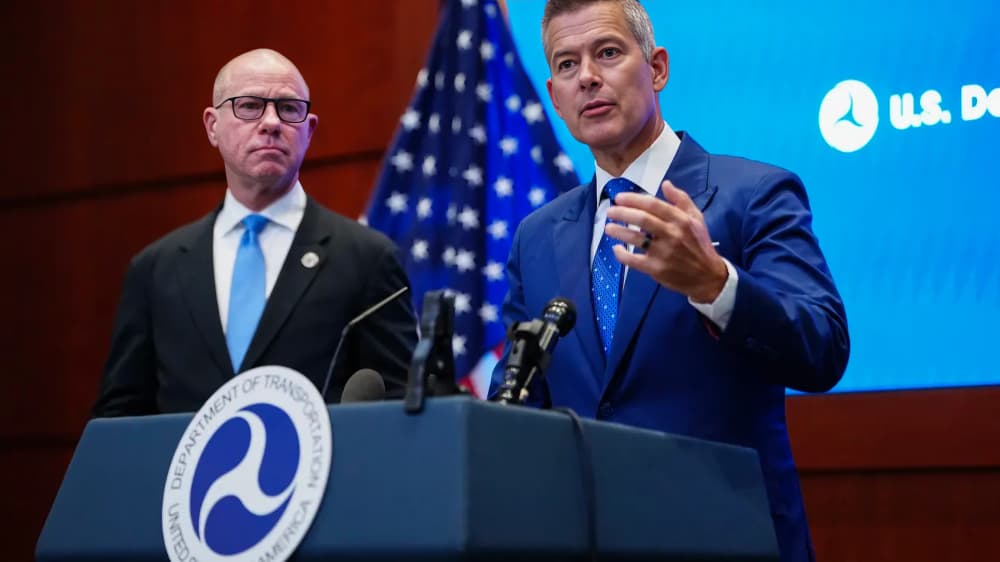
Transportation Secretary Sean Duffy said Sunday that a router installed in southern Arkansas as part of an upgrade to a system overseen by L3Harris Technologies could be key to problems that led officials to order the biggest halt to flight departures to U.S. airports since 9/11 on Friday.
“We think it was the installation or the router that was the bad actor,” Duffy said in an interview with Fox News. “We’re open if we see something else, we’re going to continue to investigate with our federal partners and law enforcement.”
Duffy told ABC’s “This Week” in a separate interview that the router was located in El Dorado in southern Arkansas. The equipment, along with another router that was in Amarillo, Texas, is at an L3Harris lab in Florida for examination, Duffy said.
He said the router, part of ongoing work to switch from copper wire to a fiber-optic system, began flooding other systems. Federal officials said on Saturday that “instability” in communication feeds and data like radar prompted the more than four-hour ground stop.
Flight disruptions lingered on Sunday but were far from the thousands of cancellations passengers faced on Friday and Saturday.
There was “zero evidence” that the problem was caused by something “nefarious” or anything related to artificial intelligence, Bryan Bedford, the head of the Federal Aviation Administration, said at a press conference with Duffy Saturday morning.
Bedford said no FAA facilities went dark but that officials decided to ground flights because of “instability” in information feeds to air traffic control centers that handle en route aircraft at high altitudes and eventually to others closer to airports.
The issue occurred during “routine” upgrades of switching from a copper wire system to fiber, Bedford said.
A router had “flooded” other routers in the air traffic control system with over 1,000 connection attempts roughly every five seconds, said Duffy. That created problems with airplane communications and radar feeds, they said.
“We were unwilling to take any risk that this propagation could actually result in a center losing connectivity with aircraft,” said Bedford. He said officials weren’t sure for about 45 minutes what was causing the instability.
The outage again thrust aging infrastructure that underpins U.S. air traffic control into the spotlight, along with the country’s struggles to replace sections of it while operating the world’s busiest airspace.
“What we’re working to determine was whether we had incompetence, meaning was it user error, installator error from L3 Harris, or did they install a faulty router,” he said.
L3Harris said it is “supporting the FAA in its investigation to understand the conditions that led to the Nov. 13 ground stop of our nation’s air travel.”
The company, a longtime U.S. contractor, said it has completed more than 70% of the switch from copper wiring to fiber-optic system.
Duffy took the groundstop to seek billions more from lawmakers to modernize the system.
Rough weekend
Flight disruptions began to ease Sunday, though more than 2,000 flights were canceled. That was down from the roughly 6,500 cancellations Saturday and over 8,000 delays, according to flight-tracking site FlightAware. That’s on top of more than 9,000 U.S. flight cancellations, about a third of the day’s schedule, and more than 7,000 delays on Friday, though some disruptions were due to bad weather.
Friday had the second-highest U.S. flight cancellations since a severe blizzard and below-freezing temperatures in January, according to aviation-data firm Cirium.
Part of untangling from the ground stop included getting aircraft where they need to be. The ground stop forced many planes to divert to other airports, while dozens of planes had to park with limited gate space because flights couldn’t depart.
Airlines run one of the lightest schedules on Saturday and are deploying as many spare planes and crews as possible to get travelers and employees where they need to be as they’re eager to start fresh for the upcoming Thanksgiving holiday period.American, along with other airlines, said it would change customers’ tickets at no fee or fare difference if the outage affected their plans and that it would cap some airfares.
Around 3 million people were scheduled to fly on Saturday, according to Cirium.
The FAA had halted departing U.S. flights around 4 p.m. ET on Friday, a ground stop that lasted more than four hours, the longest such pause on departing flights in 25 years. A few flights began to depart even before the ground stop was officially lifted; however, like trans-oceanic flights that were quickly handed off to other air traffic facilities, airlines had to seek approval for them one by one.
Written by
People First